
Governance and participation bodies
Erasmus University Rotterdam (EUR) has been a legal entity under public law since 1 February 1973, established by law and located in Rotterdam.
The Higher Education and Research Act (WHW) and the Code of Good Governance for Universities
The Higher Education and Research Act (WHW) sets out the rules and guidelines of the Ministry of OC&W that form the basis for the governance, the obligations and responsibilities of the universities. The Higher Education and Research Act lays a foundation for matters such as funding methods, staffing policies, accreditation of degree programmes, the range of programmes offered and collaborations.
The EUR’s governance is designed in accordance with the Code of Good Governance for Universities, drawn up by Universities of the Netherlands (UNL). Under this code, the Executive Board and the Supervisory Board work together on the basis of a transparent form of governance and supervision with good engagement with participation bodies.
This is done with a particular focus on:
- the responsibility of the various governance levels; in addition to the Supervisory Board and the Executive Board, deans and faculty boards are also held accountable for their governance role, as they have significant responsibilities within the university both under law and in practice;
- the importance of an open culture and a safe work and study environment;
- the role and powers of the participation bodies;
- the effective design of the governance of collaborations between universities, and between universities and government bodies/businesses.
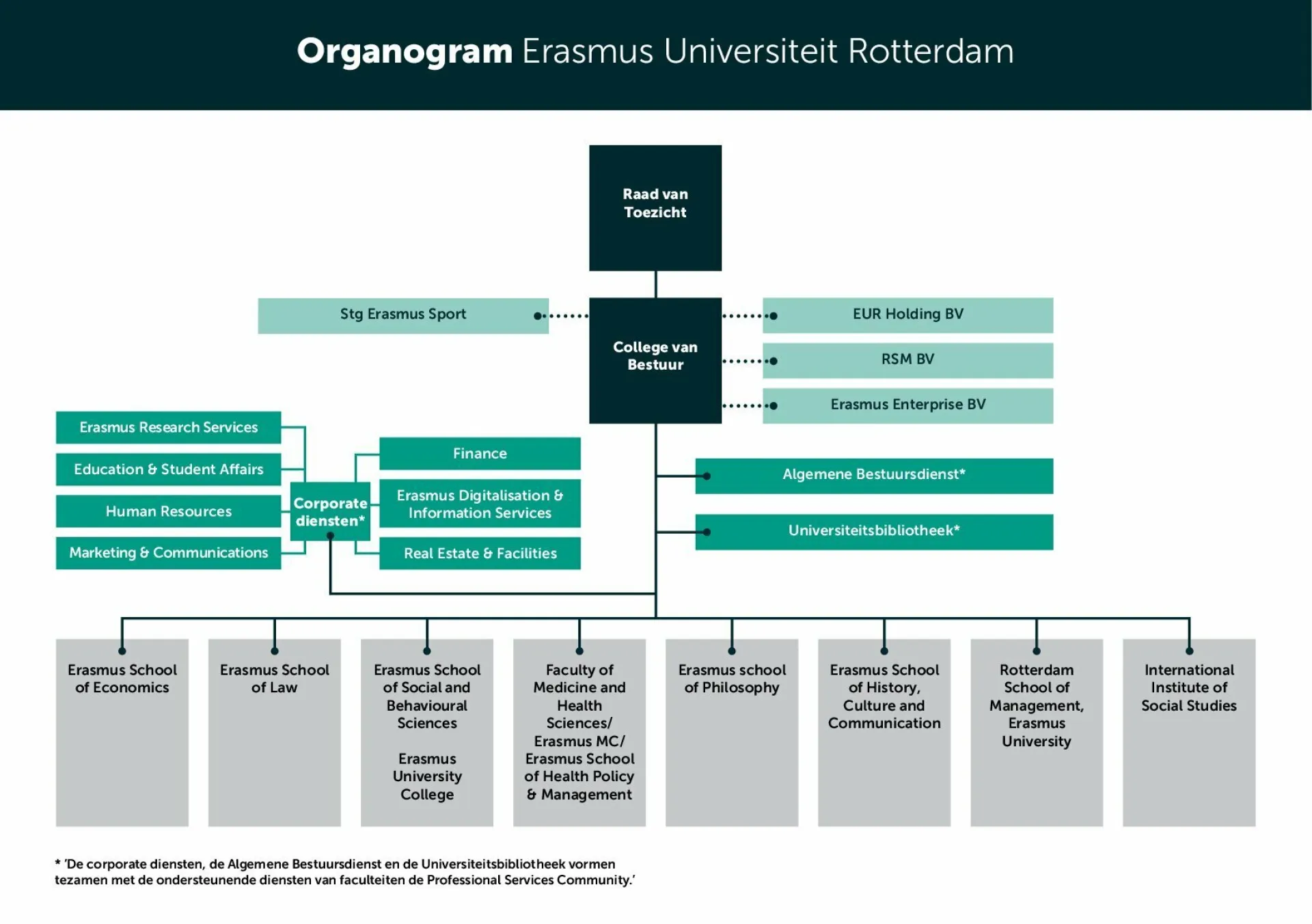
This appendix sets out an overview of the roles and responsibilities of the various governance levels at EUR: the Executive Board, the Supervisory Board and the deans. In addition, the role of the participation bodies is described in detail. In that connection, the EUR Central Election Office is also important.
One of the provisions of the Higher Education and Research Act (WHW) and the Code of Good Governance for Universities is that the members of the Supervisory Board and Executive Board are transparent about their ancillary positions. This appendix therefore also contains an overview of the ancillary positions held in the 2025 reporting year.
EUR has various diligent procedures to ensure a safe work and study climate; you can read more about those procedures elsewhere in this annual report. In that connection, we describe the EUR complaints policy in this appendix.
Supervisory Board
Roles and responsibilities
In accordance with the Higher Education and Research Act (sections 9.6 to 9.9), the Supervisory Board supervises the Executive Board’s administration and management of the university and provides solicited and unsolicited advice to the Executive Board. The tasks of the Supervisory Board include approving the strategic plan, budget, annual report and financial statements, as well as the university’s Administration and Management Regulations. The Supervisory Board is accountable to the Minister of OC&W, who appoints the members of the Supervisory Board.
Members of the Supervisory Board in 2025, ancillary positions and terms of office
Prof. J.W. (Jaap) Winter, Chair of the Supervisory Board, Partner at the consultancy firm Phyleon Leadership & Governance
- Professor of Corporate Law Governance & Behaviour at VU University Amsterdam
- Professor of International Business Law at the University of Amsterdam
- Chair of the Supervisory Board of Royal Schiphol Group N.V.
- Chair of Stichting Continuïteit ASR Nederland
- Chair of the Supervisory Board of the IMC Weekend School Foundation (from November 2024)
Term of office 1 June 2024 to 31 May 2028.
Prof. E. (Ellen) Giebels, Vice-Chair of the Supervisory Board and Chair of the Quality Committee, Full Professor of Social Psychology of Conflict and Safety, Member of the University of Twente TNO Strategic Advisory Council on Defence and Security
- Member of the Strategic Advisory Council TNO Defence and Security
- Member of the Scientific Advisory Board for the Police
- Member of the Advisory Board of LOWI (on the recommendation of the NWO
Term of office 1 June 2024 to 31 May 2028.
Dr R. (Rahul) Vas-Bhat, Chair of the Audit Committee and Supervisory Board member, Chief Financial Officer of Caldic BV No ancillary positions in 2025
Term of office 1 March 2022 to 28 February 2026.
Prof. E. (Elmer) Sterken, member of the Supervisory Board and member of the Quality Committee, Professor of Monetary Economics, University of Groningen
- Chair of the Supervisory Board, University of Humanistic Studies
- Member of the University of Tartu Council
- Member of the CPB Central Planning Committee
- Member of the Higher Education Efficiency Committee (from October 2025)
- Member of the Supervisory Board of AOG Holding BV (from October 2025)
Term of office 1 August 2023 to 31 July 2027.
Ms A. (Angelique) Berg, member of the Supervisory Board and member of the Audit Committee, Director-General of Statistics Netherlands
- Member of the Supervisory Board and member of the Audit Committee for Finance & Real Estate of Forensic Care Specialists
Term of office 1 June 2024 to 31 May 2028.
Members of the Executive Board: portfolios, ancillary positions and term of appointment
The members of the Executive Board are appointed by the Supervisory Board and report to the Supervisory Board with regard to the policies and management they have implemented.
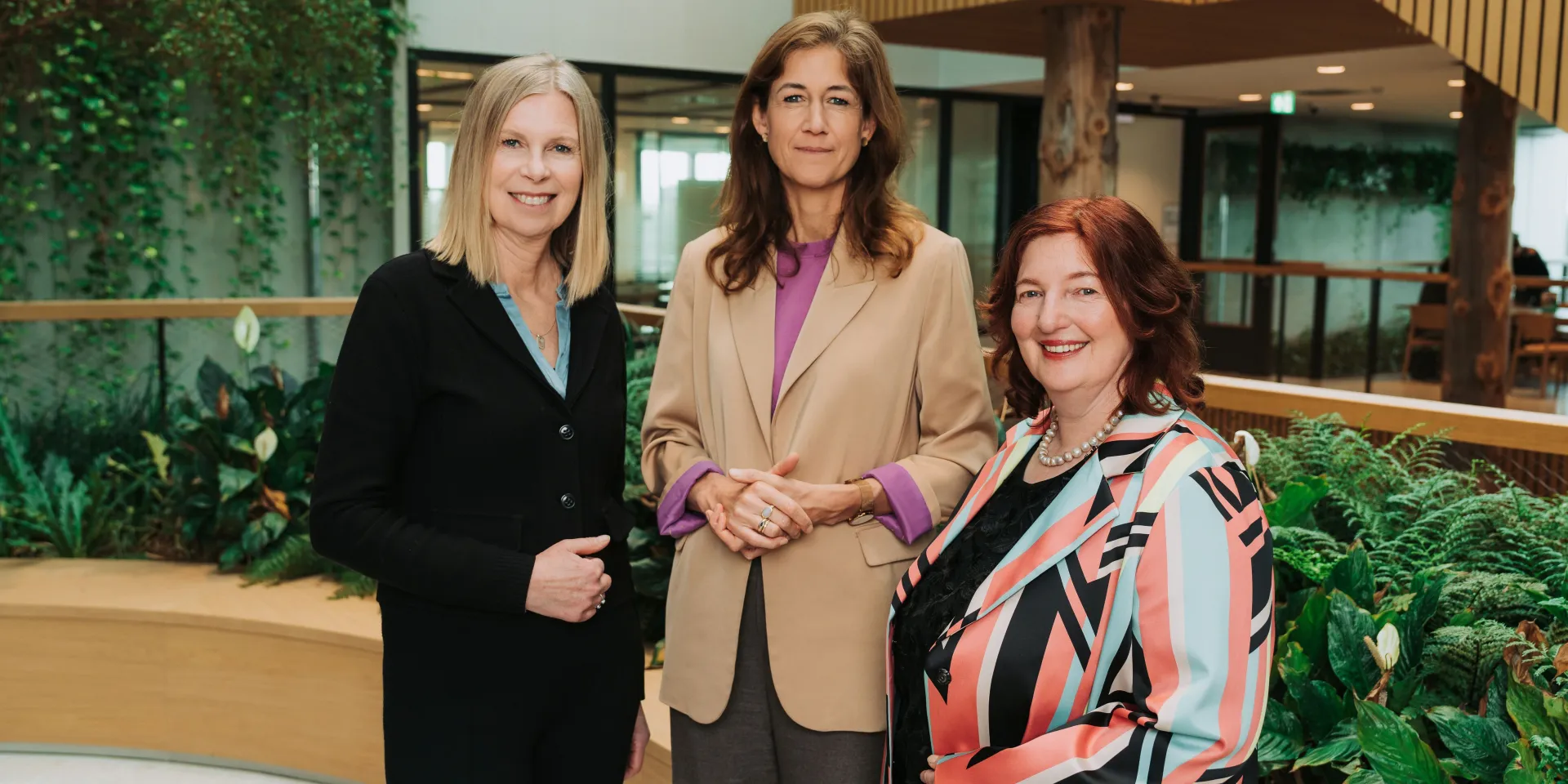
President – Prof. A.L. (Annelien) Bredenoord
The President is responsible for general administrative matters within the university. The President’s portfolio includes strategic policy, HR including diversity and inclusion, security, regional, national and international collaboration and interactions with Rotterdam City Council and the Ministry of Education, Culture and Science.
Ancillary positions in 2025:
- Chair of the D66 Programme Committee (2025 House of Representatives elections)
- Chair of the Supervisory Committee for the Netherlands Institute for Social Research (Sociaal Cultureel Planbureau, SCP)
Term of office: 1 September 2024 to 31 August 2028.
Rector Magnificus – Prof. A.J. (Jantine) Schuit
The Rector Magnificus is responsible for the portfolio of education, research and valorisation (including quality), as well as the academic staffing policy, student policy and the provision of public information about science.
Ancillary positions in 2025:
- Member of the Academic Research Advisory Committee for the VSB Fund Scholarship Programme
- Member of the Executive Board of Universities of the Netherlands (UNL)
- Chair of the Education and Research Steering Group, Universities of the Netherlands
- Member of the Social Safety in Higher Education and Academia Steering Group
- Member of the Governing Board of the European Alliance for Social Sciences and Humanities.
Term of office: 1 November 2024 to 31 October 2028. Vice-President – Dr E.M.A (Ellen) van Schoten, RA
The Vice-President manages the finance, professional services, real estate, sustainability and IT portfolio and is responsible for EUR’s private entities and the ongoing development of operational management in the interests of EUR’s strategic and other objectives.
Ancillary positions in 2025:
- Chair of the eScience Centre
- Member of the Supervisory Board of the Rotterdam Philharmonic Orchestra
- Member of the Accelerating Circular Economy South Holland (ACCEZ) Board
- President of the Supervisory Board of EUR Holding
- Chair of the Supervisory Board of Erasmus Enterprise
Term of office: 1 January 2025 to 31 January 2028
Deans
The deans are responsible for the quality of the education and research in their faculty. In 2025, two changes took place, namely at Erasmus School of Philosophy (ESPhil) and Erasmus School of Social and Behavioural Sciences (ESSB).
- Prof. P.J.F. (Patrick) Groenen, Dean of Erasmus School of Economics (ESE)
- Prof. M.J. (Maarten) IJzerman, Dean of Erasmus School of Health Policy Management (ESHPM)
- Prof. A.S. (Aukje) Hassoldt, Dean of Rotterdam School of Management (RSM)
- Prof. H. (Harriët) Schelhaas, Dean of Erasmus School of Law (ESL)
- Prof. Marjolijn Antheunis succeeded Prof. V.J.J.M. (Victor) Bekkers as Dean of Erasmus School of Social and Behavioural Sciences (ESSB) on 1 April 2025, following his retirement.
- Prof. M. (Martine) van Selm, Dean of Erasmus School of History, Culture and Communication (ESHCC)
- Prof. L.H.J. (Liesbeth) Noordegraaf-Eelens succeeded Prof. H.A.E. (Hub) Zwart on 1 October 2025 (after a year as acting dean), following his sabbatical leave and subsequent early retirement as Dean of Erasmus School of Philosophy (ESPhil)
- Prof. S. (Stefan) Sleijfer, Dean of the Faculty of Medicine and Health Sciences (FGG Erasmus MC)
- Prof. R. (Ruard) Ganzevoort, Rector of the International Institute of Social Studies (ISS)
Employee and student participation
Employee and student participation is assured through several bodies at EUR:
- the University Council (Universiteitsraad, UR), which has an EUR-wide perspective;
- the representatives of the trade unions, who sit on the Erasmus Labour Council (ELC);
- the various faculty and service unit advisory boards;
- the programme committees.
An overview of the various participation bodies:
University Council
The University Council (UR) is the participation body for the whole of EUR. The University Council is made up of twelve students and twelve employees, all elected by the university community. University Council elections are held at the start of each academic year. The student representatives are elected annually, while the staff representatives are elected every second year. See below for the members who sat on the Council until 1 September and the members who sat on the Council after 1 September 2025. The University Council liaises with the representatives of the Erasmus Labour Council (ELC), faculty advisory boards, service unit advisory boards and programme committees.
The Executive Board met monthly with the University Council in 2025 to discuss a jointly prepared agenda. These meetings covered the legally required topics, as well as topics that the Executive Board and the University Council wished to discuss with each other. The University Council can provide advice when requested and on its own initiative.
Quarterly consultations take place between the central and decentralised participation bodies (ELC, faculty advisory boards, service unit advisory boards and programme committees) at the University Council’s initiative. Working groups have been set up by the University Council and relevant policy staff for the joint implementation of the Administrative Agreements, for enabling close involvement in EUR’s strategic plan and for EUR’s sustainability goals. The University Council’s Presidium was represented at all academic ceremonies.
Members of the University Council up to 1 September 2025:
Chair: Luca Hellings (student at EUR) Staff members:
Albert Wagelmans (ESE), Aleid Fokkema (ESHCC), Emese von Bone (ESL, until January 2025) Federica Violi (ESL, from January 2025), Ernst Hulst (ESHPM), Jaap Cornelese (PRO), Jasper Klasen (FGG/Erasmus MC), Katarzyna Lasak (RSM), Linda Dekker (ESSB), Max Wagenaar (ESPhil), Rosita Boedhai (ISS), Sebastiaan Kamp (PRO), Wesley Hennep (ESSB, until February 2025), Clara Egger (ESSB, from February 2025).
Student members:
Achrad Taoul, Bachar Farousi, Jaron Buitelaar, Daan de Boer, Deniz Alican, Esra Kahramanoglu, Hugo Speelman, Luna Becirspahic, Nawin Ramcharan, Reinier van Woerden, Sara Ouljour, Timo Zandvliet.
Members of the University Council from 1 September 2025:
Chair: Luca Hellings (student at EUR) Staff members:
Albert Wagemans (ESE), John Hays (FGG/Erasmus MC), Caressa Bol (ESHPM), Federica Violi (ESL), Hans van Oosterhout (RSM), Linda Dekker (ESSB/EUC), Clara Egger (ESSB/EUC), Max Wagenaar (ESPhil), Iwona Gusc (ESHCC), Jaap Cornelese (PRO), Sebastiaan Kamp (PRO) and Rosita Boedhai (ISS).
Student members:
Bilal El Allouchi, Bodi Winkler, Borja Ranzinger, Deniz Alican, Dogukan Demirbuken, Joseph Ayinla, Lourdes Wansink Manglano, Manuela Bartolovic, Mohamed Khalil, Rik Alleleijn, Simon Maas and Wesley Hennep.
Advisory boards
Each of the supporting service units (of the administrative units Professional Services, the General Management Directorate and the University Library) has been represented by its own advisory board since 1 November 2016. These advisory boards regularly consult with the heads of the relevant organisational units. Representatives from the advisory boards liaise with representatives of the University Council and ELC.
Erasmus Labour Council (ELC)
In this local consultative committee, the Executive Board makes agreements with the representatives of the trade unions, who sit on the ELC. The General Education Union, FNV Overheid and CNV unions are represented in the consultative committee.
During the 2025 reporting year, the ELC met eight times with the President of the Executive Board and the HR Director.
Central Election Office
EUR’s Central Election Office (CSB) organises the elections for the University Council and the advisory boards of the central supporting service units. The Central Election Office also coordinates the activities of the faculty election offices, which organise the faculty council elections.
For the University Council, staff are represented by organisational unit based on individual candidacies, while students vote in an EUR-wide election based on electoral lists of candidates.
The University Council Election Regulations stipulate that the Central Election Office must hold public meetings to confirm the nominations and the election results. Through these public meetings, the Central Election Office aims to increase transparency around the decision-making process.
In 2025, the Central Election Office had a significant workload. Accordingly, as of 1 January 2026, the Central Election Office has two additional members, bringing the total number of members to seven (excluding the secretary and clerk, and including one student member). The majority of the members have a legal background. This will strengthen the continuity and expertise of the Central Election Office.
Complaints Policy
EUR handles submitted complaints, objections and appeals in accordance with legally prescribed procedures. The way cases are handled is described in various regulations published on the EUR website.
As well as formal notices of appeal, notices of objection, reports and complaints under the General Administrative Law Act (Algemene wet bestuursrecht) and the Higher Education and Research Act (WHW), EUR also handles complaints of a more general nature, such as those referred to in section 7.59a of the WHW (the Legal Protection Facility).
In 2025, 335 students (in 2024: 280) filed appeals with the EUR Board of Appeal for Examinations. These mainly concerned decisions regarding negative binding study advice, admission to a master programme and examinations.
Seven cases (in 2024: 8) were appealed to the Council of State. This included five appeals against a decision of the Board of Appeal for Examinations and two against a recommendation of the Student Disputes Advisory Committee.
Furthermore, a total of 63 (in 2024: 104) notices of objection were handled by the Advisory Committee for Complaints and Objections (15) and the Student Disputes Advisory Committee (48) in 2025. These mainly concerned decisions taken by or on behalf of the Executive Board.
17 complaints were handled in 2025 by the Research Integrity Committee (4), Committee for Undesirable Behaviour (10) and Whistleblower Committee (3) (compared with 4 in 2024).
In addition to the notices of appeal and notices of objection submitted, 158 complaints, reports and requests were submitted to EUR’s Legal Protection Facility in 2025 (compared with 271 in 2024). All institutions of higher education are required by law to have such a facility.